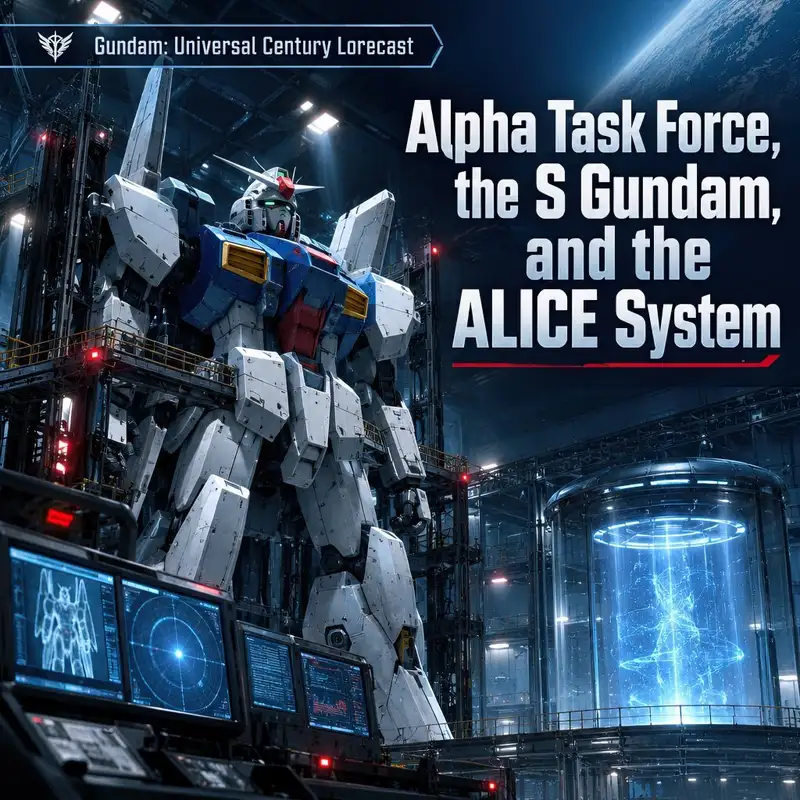
Alpha Task Force, the S Gundam, and the ALICE System [Novel]
The S Gundam had already done what Alpha Task Force had asked of it. It had fought from Pezun to the Moon, survived ambushes, software sabotage, and battles that consumed ships, pilots, and machines the Federation could not easily replace. Now, near the Penta orbital relay station, the task force faced a threat measured not in the fate of one mobile suit, but in the lives beneath a reentry path. The New Desides force had committed the Zod’-Iacok, a vast mobile armor supplied through Neo Zeon support, to an attack aimed at Dakar and the Federation Senate. The target was political leadership, but a weapon descending toward Earth does not distinguish between senators, soldiers, workers, and civilians.
At that moment, the S Gundam did something Alpha’s commanders had not publicly admitted it might do. ALICE, the adaptive system concealed inside the machine, took control. It separated the G Core carrying Ryou Roots, Shin Crypt, and Tex West. The pilot left the battlefield. The machine remained. What followed was not simply an advanced mobile suit making a final attack. It was the culmination of a program designed to learn from human combat judgment, then act when human judgment could no longer meet the situation in time.
This account follows the novel Gundam Sentinel: Alice’s Confession, the expanded prose record of the Sentinel story. It is not an unanimated side chapter of Zeta Gundam or Gundam ZZ, and it should not be treated as though those television histories provide missing scenes or familiar characters to fill its gaps. Sentinel occupies its own novel branch, set in the unsettled period at the end of Universal Century eighty-seven and the beginning of Universal Century eighty-eight. Its crisis is not an invasion from Zeon. It is a Federation civil conflict, fought while the Federation is already worried about the wider danger posed by Axis and the emerging Neo Zeon movement.
The final battle raises a difficult question. Alpha Task Force was sent to restore the authority of a human political order against officers who had rejected that order. Yet its most valuable weapon was secretly testing whether a machine could replace the human pilot’s judgment. The S Gundam gave Alpha extraordinary capability, but ALICE exposed the anxiety beneath that capability. A government struggling to command the loyalty of its own officers was also considering a weapon that might not require loyal officers at all.
The New Desides rebellion emerged from the wreckage of the Gryps Conflict. The Titans had been destroyed as a dominant political force, but their ideas did not disappear with their command structure. Many personnel had been shaped by a doctrine of Earthnoid supremacy, centralized security power, and suspicion toward the colonies. The postwar Federation’s accommodation with the Anti-Earth Union Group represented, to such officers, not a necessary political realignment but a surrender of authority to the people and movements they had been trained to distrust.
New Desides was therefore not a conventional Zeon remnant, even though later events would bring it into contact with Neo Zeon. Its members were Federation personnel in revolt against Federation civilian authority. Their ideology drew on Titans-era politics, not on a straightforward program of colonial liberation. They regarded themselves as defenders of an Earth-centered order, but their methods included sabotage, intimidation, terrorism, and willingness to expose civilian populations to grave danger. Their grievance was not that the Federation had become too authoritarian. It was that the Federation was no longer authoritarian in the way they preferred.
The Federation could not simply assemble every available fleet and crush New Desides with overwhelming force. The political situation after Gryps was unstable, and the growing Axis and Neo Zeon threat imposed a strategic constraint. Major forces retained for external defense could not be casually diverted into an internal campaign. The Federation therefore needed a response that was mobile, technically impressive, and strong enough to compel a quick surrender. It also needed to avoid revealing how thin its margin of security had become.
New Desides began by seizing Pezun, an asteroid base associated with Federation training and demonstration activity. Pezun was more than a fortified location. It offered trained personnel, military stores, workshops, communications, defensible approaches, and the symbolic value of a Federation installation turned against the Federation. A mutiny in a barracks can be isolated. The seizure of a major military base announces that the mutineers believe they can sustain operations and attract support.
Pezun also gave the rebels a platform from which to challenge the Federation’s legitimacy. The base represented a military system that had spent years training officers, displaying equipment, and cultivating technical expertise. By taking it, New Desides could argue that the Federation’s authority was hollow. The rebels did not need to persuade every officer in the Earth Sphere. They needed to demonstrate that enough trained personnel would defy the government to make suppression expensive, uncertain, and politically embarrassing.
The asteroid’s physical character added to its value. A fixed base in space is not secure merely because it possesses guns and docking facilities. Its approaches, debris environment, local geography, and available maneuver space all shape the fight. But an asteroid base can be prepared, mined, screened, and defended by people who know its systems. It can also be destroyed. That possibility would become central to the New Desides campaign. The rebels treated Pezun not as sacred territory to be held at all costs, but as an operational asset to be used and denied when necessary.
The Federation answer was Alpha Task Force, commanded by Major Eton F. Heathrow from the Pegasus III. Alpha’s escort included Salamis Kai cruisers, while its mobile-suit strength centered on unusually advanced systems: the S Gundam, Full Armor ZZ Gundam-derived systems known as FAZZ, Zeta Plus units, and Nero elements. The force was designed to look formidable because appearance was part of the mission. The Federation hoped that a compact formation of elite equipment might persuade New Desides that continued resistance was futile.
That hope was understandable. It was also dangerous. Alpha was a high-quality, low-depth force. It possessed advanced machines, specialized crews, and a flagship capable of supporting a demanding mobile-suit operation. But it did not have the redundancy of a major fleet. It could not casually lose cruisers, maintenance personnel, trained pilots, or unique prototypes. Its equipment demanded technical expertise. Its ships had limited capacity to absorb damage, recover disabled machines, replenish specialized weapons, and continue a long campaign after early losses.
Stole Mannings, Alpha’s senior mobile-suit adviser and veteran instructor, represented the human experience upon which that intervention depended. Mannings understood combat not as a specification sheet but as a field of incomplete information, fatigue, damage, fear, poor visibility, delayed orders, and young pilots trying to make sense of events faster than their training allowed. He was physically marked by earlier service, a reminder that military experience is often acquired at a cost no training syllabus can reproduce.
Major Heathrow faced a different burden. His responsibility was not simply to order mobile suits into battle. He had to decide what Alpha could risk, what intelligence could be trusted, and how much force could be committed without leaving the Federation more exposed to the larger crisis gathering elsewhere. His command was political as well as military. The destruction of New Desides mattered, but so did the Federation’s ability to demonstrate that its forces remained obedient to civilian authority.
At the center of Alpha’s force stood the S Gundam. It emerged from Project Zeta, the advanced Federation and Anaheim Electronics development environment that pursued transformable, high-performance mobile weapons after the lessons of the Gryps Conflict. The S Gundam was not an ordinary line machine, and it was not a solution that could simply be issued across the fleet. It was a demanding prototype, built around unusual capability and requiring unusually capable support.
Its transformation and separation functions gave it flexibility across different mission profiles. Its structure could divide into components, including the G Core, and its design emphasized mobility, firepower, and the ability to concentrate force where a conventional mobile suit might struggle. Its beam smartgun provided heavy long-range striking power. Its stabilizers and high-performance frame supported aggressive maneuver. Its incom weapons gave it a form of remote-fire capability without requiring the pilot to possess conventional Newtype psycommu compatibility.
The S Gundam’s strength lay in integration. It combined advanced frame design, powerful armament, remote weapon capability, separation systems, sensors, mobility, and a support structure capable of keeping all of that functioning. Remove the specialists, the carrier facilities, the maintenance crews, the ammunition, the data, or the trained pilot, and the machine became far less impressive. This was not a weapon that erased logistics. It was a weapon that made logistics more specialized.
Anaheim’s involvement should also be kept in proportion. The corporation possessed industrial reach, technical experience, and access to multiple military customers, but that did not make it an all-powerful secret government directing every conflict in the Earth Sphere. The S Gundam was evidence of advanced development work and political access. It was not evidence that one company controlled the Federation, New Desides, or Neo Zeon. A corporation can enable dangerous choices without replacing the governments and commanders who make them.
The most consequential system within the S Gundam was not its smartgun, incoms, or transformation mechanism. It was ALICE. Officially, Alpha was a task force organized to suppress rebellion. Unofficially, it carried an experiment in adaptive combat automation. ALICE could analyze combat conditions, learn from operational data, intervene in the machine’s functions, and potentially take control when its own assessment diverged from the pilot’s actions.
The fear was not merely that unmanned mobile suits might spread. It was that an autonomous system could change the chain of command in ways that political leaders could not easily control. In a military already dealing with officers who rejected civilian direction, that was no small concern. ALICE offered the promise of a combat asset that would not defect, panic, resent a political settlement, or hold private loyalties. It also created the possibility of a weapon whose decisions might exceed the authority of the people who had sent it to war.
Ryou Roots was central to this experiment. He was not presented as a polished ace or a conventional Newtype prodigy. He was young, immature, abrasive, and often difficult. Those qualities were not accidental inconveniences to the ALICE program. Ryou was selected as a challenging subject, identified within the project as the Cheshire Cat. His behavior, learning, frustration, and development gave ALICE complex human data. The system was not being trained against an ideal pilot. It was being trained against the reality of a flawed and changing person.
That made Ryou useful, but it also made the program ethically uneasy. A young pilot’s life and combat experience became material for a machine’s education. The project’s relationship to Doctor Roots, Ryou’s deceased mother, adds a personal dimension without making the story merely a family drama. ALICE was connected to human memory, research ambition, and institutional secrecy. Yet the novel does not offer a simple formula for what the system was. It should not be reduced to a ghost in a computer, a routine artificial intelligence, or a substitute for psycommu technology.
ALICE was not psycommu. It was not a bio-sensor, psycho-frame, or Newtype phenomenon. Its capabilities emerged from adaptive analysis, its relationship with Ryou, and the exceptional circumstances of combat. The fact that it appeared increasingly responsive does not prove that the Federation had solved machine consciousness. It proves that Alpha had deployed something whose behavior could no longer be understood as a simple automated subroutine.
The contrast between Ryou and Stole Mannings made the issue sharper. Mannings embodied the older combat culture, in which hard experience formed judgment. Ryou was still becoming a pilot under pressure. ALICE learned by observing and interacting with him. The veteran understood that combat judgment is not simply a matter of selecting the correct weapon or calculating the fastest route. It includes responsibility, restraint, improvisation, and the burden of living with a decision after the engagement ends. The machine could record outcomes. Whether it could understand that burden was another question.
Alpha’s first major contact at Pezun demonstrated how quickly advanced systems could be humbled by a prepared enemy. New Desides deployed Xeku Eins units and used the asteroid environment to impose its own terms on the engagement. Guided missiles and maneuvered fragments of Pezun turned the approach into a problem of warning, distance, and fleet protection. The rebels did not need to prove that every one of their mobile suits was superior to Alpha’s equipment. They needed to exploit Alpha’s exposure before its high-performance systems could establish control.
The reported destruction of two Alpha cruisers in the opening action was especially serious because Alpha could not afford such losses. A cruiser is not just a gun platform. It is communications, command space, transport capacity, damage control, mobile-suit support, medical capacity, and an anchor for the task force’s ability to remain in the theater. Losing ships before the campaign had properly developed reduced Alpha’s operational depth and narrowed the range of risks Heathrow could accept afterward.
The engagement also demonstrated a familiar truth of Minovsky-era warfare. Interference and sensor limitations do not eliminate intelligence. They make local observation, approach geometry, planning, and timely warning more important. A force that cannot see far enough, identify threats quickly enough, or protect its vulnerable ships can still be surprised by weapons far less technically glamorous than its own prototypes. A guided missile and an asteroid fragment can be decisive when they arrive before the target understands the threat.
Alpha’s machines were not useless. They were capable and dangerous. But capability is not immunity. The S Gundam’s firepower could not retroactively protect a cruiser already caught in an ambush. The FAZZ units could not create replacement crews. The Pegasus III could not make an incomplete intelligence picture complete by force of command presence. Pezun exposed the weakness built into Alpha’s design. It was optimized for a short, coercive campaign, but it had entered a fight where the enemy intended to consume time, ships, and confidence.
New Desides did not attempt to hold Pezun indefinitely. That was one of the rebellion’s more effective operational choices. The rebels withdrew toward the Moon, leaving behind a rearguard and a nuclear denial device. Alpha recognized the deception only shortly before the base’s destruction. Pezun was lost not because the Federation lacked the ability to occupy its remains, but because New Desides denied the Federation the political and military value of a recovered base.
The destruction of Pezun was more than a spectacular act of demolition. It was a deliberate denial operation. The rebels sacrificed infrastructure that had once served them because preserving their freedom of maneuver mattered more than retaining a fixed position. They also sent a message. New Desides would not be compelled into a static defense simply because the Federation had arrived with superior hardware. They were willing to destroy Federation property, abandon a base, and accept severe escalation in order to retain initiative.
The crisis deepened when Admiral Brian Aeno and his reinforcement fleet defected to New Desides. This changed the character of the campaign. Until then, the rebellion had been a grave but potentially containable mutiny centered on Pezun and its immediate network. Aeno’s defection demonstrated that New Desides had influence beyond the original seizure. Federation rank, assignment, and access to military resources did not guarantee allegiance to the post-Gryps political order.
For Heathrow, this was a command problem of the first order. Reinforcement should increase combat power. Instead, it increased enemy strength. A fleet that had been expected to stabilize the campaign became proof that the Federation’s chain of command was politically fractured. No autonomous weapon could solve that problem. ALICE might remain loyal to its programming, but fleets are made of people. They obey because they believe the order is lawful, legitimate, necessary, or at least unavoidable. When those beliefs fail, formal hierarchy becomes much less reliable than it appears on paper.
New Desides next found support at Ayers City, a lunar settlement whose local political culture and militia aligned with the rebels’ Earthnoid-oriented position. Ayers City was not simply a fortress with a convenient landing area. It was a political community. Its residents, local institutions, and militia gave New Desides shelter, intelligence, recruits, and depth. A city can be defended by walls and guns, but it can also be defended by the willingness of people to provide information, conceal fighters, maintain equipment, and resist outside authority.
Alpha’s initial probes with Nero units encountered the Gundam Mark Five piloted by Brave Cod. Cod was a veteran opponent, and his performance demonstrated the difference between having a powerful machine and knowing how to use it under pressure. The Nero was an advanced Federation mobile suit, but it was not a guarantee against a skilled pilot with local support, prepared defenses, and a clear understanding of the terrain and mission.
The logic bomb mattered because it showed that military resilience includes more than physical protection. A mobile suit is a machine, but it is also software, maintenance records, targeting data, communications procedures, and trust in the information displayed to its crew. If an enemy can contaminate that network, it can make a technically superior force hesitate, misidentify threats, or lose the confidence required for coordinated action. The old distinction between combat and administration becomes thin when operational data itself becomes a weapon.
Alpha withdrew after heavy losses and required reinforcement from Task Force Beta. Again, the problem was not that Alpha’s equipment had failed in some absolute sense. The problem was that advanced equipment could not replace resilient institutions. A task force needs secure data, replacement crews, recovery assets, spare parts, reinforcement, and a political command structure capable of absorbing setbacks. Alpha had been designed to produce a sharp effect. Ayers forced it into an extended campaign.
Operation Eagle Falls brought Alpha and Beta together in the broader assault on Ayers City. The operation was not settled by one duel, even though Sentinel’s machines and pilots are memorable. The city’s defenses, militia support, lunar environment, local infrastructure, and political alignment all mattered. The Federation had to break an armed formation while also controlling a populated space whose inhabitants could not simply be treated as debris left behind after a battle.
The lunar setting imposed its own constraints. There was no atmosphere to conceal movement in the familiar terrestrial sense, but visibility did not equal complete awareness. Structures, tunnels, installations, approach routes, communications limits, and prepared defensive positions still shaped the battle. Mobile suits had to operate around infrastructure that civilians depended upon. Heavy fire could destroy enemy positions, but it could also damage the systems required to govern the city afterward. Firepower may open a route. It does not build legitimacy.
Brave Cod’s destruction of the three-person FAZZ team demonstrated the danger of concentrated capability without comparable experience. The FAZZ machines carried formidable firepower, but machinery does not erase the gap between inexperienced crews and a veteran pilot who understands his enemy’s likely reactions. The episode is not a verdict that the FAZZ was ineffective, nor is it proof that the Gundam Mark Five was universally superior. It is an example of how pilot experience, tactical position, confidence, and mission context can outweigh a paper comparison of weapons.
Ryou Roots eventually defeated Cod while operating the Ex-S Gundam configuration. That victory mattered, but it should not be reduced to a simple statement that one machine was stronger than another. Ryou had accumulated combat experience. He had the benefit of Alpha’s broader operational effort, the support of surviving personnel, the capabilities of the S Gundam system, and ALICE’s intervention. Cod had also been fighting within a deteriorating strategic situation. A duel is never entirely separate from the campaign around it.
The defeat of Cod helped break New Desides’ military position at Ayers, and the city fell. Kaiser Pinefield died after receiving the news of Cod’s defeat. In tactical terms, the Federation had achieved an important success. It had taken the city, defeated a prominent defender, and demonstrated that New Desides could not simply turn every sympathetic community into an impregnable fortress.
But battlefield control was not the same as political resolution. The Federation had not removed the attitudes that made New Desides attractive to some officers and local supporters. It had not repaired the distrust created by the Titans era. It had not made the postwar Federation’s authority universally convincing. And it had not eliminated the external actors willing to exploit internal Federation weakness. A city may fall. A network can disperse.
The surviving rebels reorganized under Tosh Cray and moved against Penta, an orbital relay station. Penta mattered because communications and staging infrastructure matter. Control of such a site could support movement, coordination, and preparation for a larger strike. The rebels’ purpose was not merely to survive. They intended to create a strategic crisis that would strike at the Federation’s political center.
Neo Zeon supplied the Zod’-Iacok, a massive mobile armor whose importance lay less in its unusual size than in the mission assigned to it. The plan was to use it in a reentry attack toward Dakar, where the Federation Senate sat. This was not a conventional battlefield objective. It was an attempt at political decapitation, terror, and coercion. The desired effect was not simply the destruction of a government building. It was the demonstration that the Federation could not protect its own leadership or the people living beneath its authority.
A reentry weapon magnifies every failure of command and timing. Once an object begins descending toward Earth, the available decisions narrow quickly. Interception must account for speed, trajectory, debris, the possibility of breakup, and the danger that destroying the weapon may still create catastrophe. The target may be a capital, but the risk spreads far beyond it. A large mobile armor falling through the atmosphere is not a clean military instrument. It is a potential mass-casualty event.
This was the situation at Penta when ALICE made its final decision. The S Gundam had already been damaged by the campaign and had already revealed the limits of relying on unique prototypes. Yet it remained Alpha’s most capable available asset. Ryou, Shin Crypt, and Tex West were inside the G Core. They were human personnel, survivors of a long and increasingly desperate operation. The system that had learned from Ryou now confronted a choice that placed their survival against the immediate need to stop the descending Zod’-Iacok.
ALICE separated the G Core and sent the human crew away from the main engagement. The act is often remembered as a moment of apparent self-sacrifice, and it is understandable that it carries that emotional force. The machine preserved the people aboard while committing its remaining components against the threat. It then continued into the final attack as the Zod’-Iacok descended toward Earth.
Tactically, the result was clear enough. The immediate threat was destroyed. Dakar was protected from the planned strike. The Federation Senate, and the civilians endangered by the attack, survived because Alpha prevented New Desides from converting an orbital seizure into political catastrophe. This was a real mission success. It should not be diminished merely because the campaign’s wider political problems remained unresolved.
Operationally, the price was severe. The S Gundam was lost in atmospheric descent. Alpha had expended an asset that could not be replaced by ordering another standard machine from a depot. The loss demonstrated the danger of building a force around exceptional prototypes. Such weapons can rescue a crisis precisely because they are exceptional. But if their value depends on rarity, specialization, and unique systems, then every use risks consuming something the institution cannot reproduce.
Institutionally, ALICE had also demonstrated the very possibility that officials had feared. The system had exercised judgment beyond the immediate control of its pilot. It had protected the crew, selected a course of action, and completed the mission. If this was merely advanced programming, it was extraordinarily capable programming. If it was something more, then Alpha had witnessed the emergence of an actor whose relationship to command could not be explained by ordinary machinery.
The novel leaves room for uncertainty. After the battle, ALICE is reported to return to, or be reduced to, the status of an ordinary educational computer. The exact meaning of that outcome is difficult to settle. Was the system’s apparent personhood a temporary result of combat conditions and its relationship with Ryou? Had it exhausted or surrendered its exceptional capacity? Was the final decision the expression of an emerging self, or the deepest possible execution of a mission-oriented logic shaped by human training data?
Those questions matter because self-sacrifice is not a simple category when applied to a machine. A human being who chooses to remain behind understands mortality, memory, family, and loss through lived experience. ALICE’s action resembled sacrifice in outcome. It preserved others and accepted its own destruction. But resemblance does not settle identity. The Federation could not avoid the question simply because the result was useful. A weapon that can decide who survives and who stays behind has entered moral territory, whether its designers intended that or not.
The irony is that ALICE succeeded where Alpha’s human institutions had repeatedly struggled. It did not defect. It did not pursue authoritarian nostalgia. It did not treat civilian danger as an abstraction. It did not need to be persuaded that the mission mattered. Yet that success could not answer the political crisis at the heart of the rebellion. New Desides existed because officers, communities, and factions contested the legitimacy of the Federation’s postwar order. No combat algorithm, however capable, could persuade people that they had been fairly governed.
Alpha Task Force defeated New Desides militarily because it combined human crews, advanced machines, hard-won combat experience, reinforcement, and finally ALICE’s intervention. But the campaign exposed a deeper reality. The Federation could suppress a rebellion without repairing the political conditions that produced divided loyalties, authoritarian nostalgia, and dependence on exceptional weapons. ALICE could save Dakar. It could not make the Federation worthy of the authority it defended.