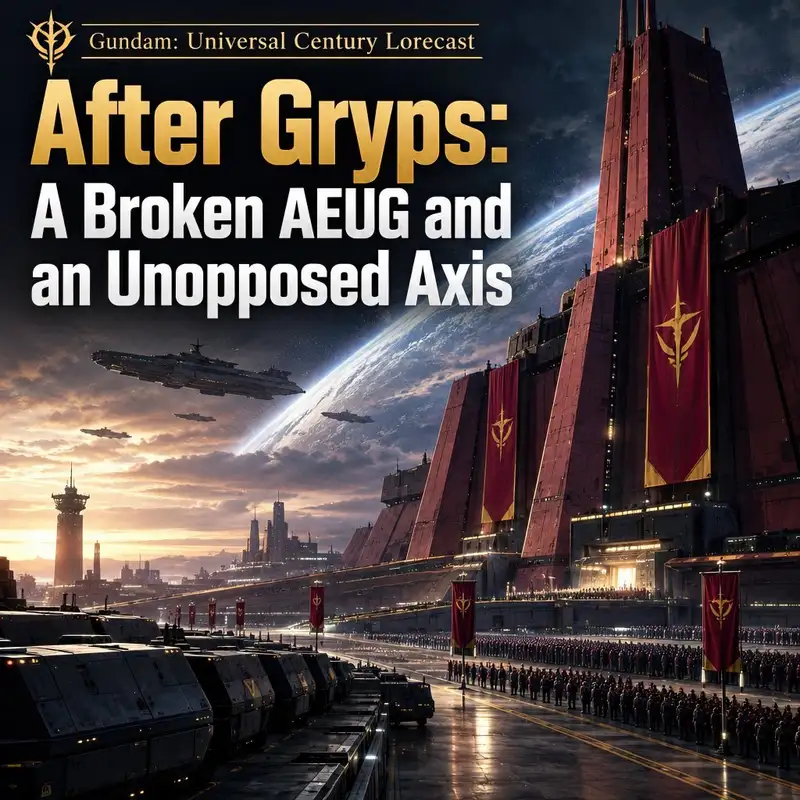
After Gryps: A Broken AEUG and an Unopposed Axis
The Argama reaches Shangri-La carrying the evidence of victory in its hull. The Titans have been broken. Gryps Two has been destroyed. The organization that once exercised terror in the name of Federation security is no longer capable of directing the Earth Sphere. Yet the ship arriving at Side One is not the spearhead of a triumphant new government. It is battered, short of dependable manpower, dependent on repairs, and forced to operate inside a civilian colony economy. Its next pool of potential pilots is not a trained replacement squadron arriving from a secure rear area. It is a group of local teenagers who know wreckage, salvage, and survival better than military procedure.
At roughly the same moment, Axis can send the Endra to Shangri-La and pursue the Argama with an organized naval force. That contrast explains the opening balance of the First Neo Zeon War. The Anti-Earth Union Group had won the Gryps Conflict. Axis, soon calling itself Neo Zeon, had preserved enough strength to exploit the peace that never arrived. One side had survived victory but lacked the means to consolidate it. The other had survived the war with a command structure, a political objective, and forces ready to move.
The important question is not why the AEUG lost the Gryps Conflict. It did not. It destroyed the Titans as an effective political and military organization. The question is what that victory actually delivered. Destroying an enemy command does not automatically grant control of its territory, its depots, its ships, its surviving personnel, its bureaucracies, or its legal authority. It does not produce a government capable of issuing orders across the Earth Sphere. And it does not replace the ships, crews, pilots, technicians, and staff officers consumed by the battle that achieved the victory.
The AEUG had fought to stop the Titans. It had not entered the war as a finished state waiting to inherit the Federation. That distinction mattered immediately after Gryps.
The Anti-Earth Union Group was a coalition. It brought together Federation personnel opposed to the Titans, military defectors, political dissidents, sympathetic civilians, independent allies, and crews willing to risk everything against a security organization that had become a threat to the people it claimed to protect. That coalition could create combat power. It could gather intelligence, move ships through friendly ports, recruit pilots, obtain equipment, and build a cause around resistance to Titans repression.
But a coalition built to resist an abusive institution is not automatically prepared to replace that institution. The AEUG did not possess uncontested authority over the Earth Federation government. It did not command every surviving Federation military formation. It did not control a unified industrial base, a stable tax system, a recognized chain of civil administration, or an agreed political program for the day after victory. Its strength lay in mobile formations, relationships of trust, and a handful of unusually capable crews and pilots. Those assets could be decisive in battle. They were much less reliable as a foundation for governing the Earth Sphere.
The Earth Federation also remained in existence. The destruction of the Titans did not mean that the Federation’s civilian government vanished, or that every regular Federation unit had been defeated. But the Federation had allowed the Titans to become powerful in the first place. Its institutions emerged from the conflict compromised, confused, and reluctant to move with clarity. The AEUG had exposed the Titans as a danger, but exposure was not the same thing as building a replacement order.
That left an awkward postwar reality. The AEUG had won the moral and military argument against the Titans, yet it lacked the political authority and material depth needed to dictate what followed.
The final phase of the Gryps Conflict had also imposed a cost that victory celebrations tend to hide. The force that reaches a climactic battle has already spent months or years losing people, machines, supplies, and confidence. It has accumulated damaged hulls, exhausted crews, casualties among experienced personnel, and shortages that cannot be corrected simply by declaring the enemy defeated.
The AEUG had fought the Titans through repeated fleet actions, mobile-suit engagements, defections, reversals, and shifting alliances. It survived because its people adapted under pressure. But adaptation is expensive. A veteran pilot is not merely a name on an operations board. That pilot carries practical knowledge of the ship, the machine, the enemy, the commander, and the peculiar methods that keep a small formation alive. A damaged mobile suit is not merely an item awaiting repair. It may require parts that are unavailable, technicians who are already overworked, and facilities that the AEUG does not securely control.
The battle around Gryps Two ended the Titans’ role as a coherent force. It did not erase the damage done to those who fought against them. The AEUG emerged technically victorious, but much of its strength had been spent obtaining that result.
Kamille Bidan’s condition makes this cost visible. He survives the final confrontation with Paptimus Scirocco, but he does not emerge ready to resume combat or provide the same influence he had carried during the conflict. In the opening of Gundam ZZ, he remains severely impaired, and Fa Yuiry’s care for him is a quiet reminder that a war does not end cleanly for the people who survive it.
It would be a mistake to treat Kamille only as a missing weapon. He was a pilot of extraordinary ability, certainly, but his incapacitation also represented a loss of experience, trust, and continuity. He had been shaped by the AEUG’s struggle and had shaped it in return. The people around him understood his strengths, his limits, and the burdens placed on him. When he could no longer function as he had before, the AEUG lost more than a mobile-suit pilot. It lost part of the human network that had held its improvised military effort together.
This was not unique to Kamille. He was simply the most visible example. The AEUG’s problem after Gryps was force regeneration.
Force regeneration is not the same as acquiring a powerful machine or finding a talented recruit. It means restoring the whole system that allows military power to operate over time. Ships need repair. Mobile suits need replacement parts, ammunition, propellant, and technicians. Crews need sleep, medical care, and a predictable chain of command. Pilots need training, instructors, simulators, maintenance teams, and units capable of absorbing inexperienced personnel without collapsing under the burden. Commanders need staffs, communications, intelligence, fuel, secure bases, and political guidance.
The Argama’s arrival at Shangri-La demonstrates the difference between survival and readiness. The ship has lived through the Gryps Conflict, but survival alone does not make it healthy. A warship can remain afloat and still be unable to sustain a prolonged campaign at full effectiveness. Damage affects more than weapons and armor. It affects hangars, maintenance spaces, stores, crew routines, medical capacity, sensors, communications, and confidence. A ship that has been in continuous action may need time that the strategic situation refuses to provide.
The AEUG had no reliable interval for recovery. It lacked an intact theater-wide structure that could quickly collect damaged ships, replace equipment, rotate personnel, and issue unified operational orders. Some support remained. Some allies remained. Federation resources still existed in the wider Earth Sphere. But the AEUG itself did not suddenly become the owner of those resources merely because the Titans had fallen.
The difference is fundamental. A military movement can defeat a stronger opponent through courage, leadership, surprise, and superior local decisions. It cannot maintain that advantage indefinitely without ports, shipyards, depots, political authority, and an administrative system capable of turning resources into sustained operations.
The AEUG had won a war against the Titans. It had not acquired a functioning postwar state.
Leadership made that problem worse. Coalitions often depend on people who can connect groups that would otherwise distrust one another. They need figures capable of translating military success into political legitimacy, negotiating with hesitant institutions, and giving scattered commanders a common purpose. After Gryps, the AEUG had lost or been separated from too many of those connective figures.
Char Aznable was not available to provide continuing leadership in the opening situation of Gundam ZZ. The television continuity leaves his immediate fate unresolved from the perspective of those dealing with the aftermath. What matters here is not to impose a later answer on that uncertainty. What matters is the practical result. The AEUG had lost the visible presence of one of its most important political and military figures at precisely the moment when it needed leadership beyond the cockpit and bridge.
Bright Noa remained. Bright was an experienced frontline commander, one of the people capable of keeping a damaged ship moving and a difficult crew focused. He understood what mobile suits, carriers, and sailors could do under pressure. He could make decisions with incomplete information and hold a formation together when more glamorous leaders had disappeared.
But Bright was not a government. He was not a replacement high command. He did not possess a recovered fleet, a settled political mandate, or the authority to direct every surviving Federation formation. His competence was essential, but competence at the level of a ship commander cannot solve a crisis of state capacity.
That is why the AEUG’s postwar weakness should not be described simply as disorder. It was a deeper problem. The organization had enough discipline to keep fighting. What it lacked was an institution able to convert sacrifice into durable authority.
Axis had a different position. It had returned to the Earth Sphere on October seventh, Universal Century eighty-seven, entering the Gryps Conflict as a third power rather than as a force already exhausted by years of direct struggle against the Titans. Axis dealt with both the AEUG and the Titans, maneuvering among opponents whose war had already weakened them. This did not make Axis invulnerable or infinitely strong. It did give Axis something rare in the aftermath of Gryps: preserved options.
Strategic preservation is often more important than a dramatic late-war victory. A force that survives with ships, trained crews, functioning command relationships, political cohesion, and enough logistical support to initiate operations may be better positioned than a force that wins the final battle at ruinous cost. Axis had participated in the conflict, but it had not been destroyed alongside the Titans or depleted to the same degree as the AEUG.
That preservation gave Axis freedom of action. Its leadership could decide where to apply pressure. Its ships could move with a common purpose. Its forces could threaten colonies, pursue surviving AEUG units, and prepare for operations on Earth. The organization did not have to spend every day proving that it still existed.
Axis also retained a political identity. It was not merely a collection of armed survivors in search of a cause. It carried the Zabi legacy, the memory of Zeon’s defeat, and the claim that the Earth Sphere’s political order remained unsettled. Those claims did not make its program just. They made it legible. In a confused postwar environment, a force that can tell its supporters, enemies, and neutral parties what it wants has an advantage over a coalition still trying to determine what victory means.
Axis had limits. It did not control the entire Earth Sphere. It could not assume that every colony would welcome it, or that every Federation formation would collapse. Its own leadership and internal loyalties would prove fragile. But the central fact of early Universal Century eighty-eight was relative readiness. Against a battered AEUG and a hesitant Federation, Axis possessed a coherent command center able to act first.
Under Haman Karn, that command center became Neo Zeon. Haman’s project was not simply to hunt the Argama or settle accounts with the AEUG. Those were military tasks within a larger political objective. She sought to turn Axis from a surviving Zeon force into an authority that the Earth Federation and the colonies would have to recognize. Her weapons were fleets, mobile suits, deployments to Earth, political symbolism, intimidation, negotiation, and the willingness to use catastrophe as leverage.
This was not a straightforward continuation of Zeon Zum Deikun’s political philosophy. Deikun’s ideas about Spacenoid independence and humanity’s future had been transformed, contested, and exploited long before Axis entered the Earth Sphere. Haman’s authority rested on something more immediate: control over Axis forces, the legitimacy claimed through the Zabi name, the vulnerability of the Federation, and her own ability to organize power around those assets.
Her objective was recognition. Neo Zeon needed to be treated not as a remnant to be ignored, but as a government and military power capable of demanding concessions. That required more than battlefield success. It required creating situations in which other governments believed they had no safe alternative but to bargain.
This is why Neo Zeon’s early campaign cannot be understood as a simple series of mobile-suit battles. Its operations were political instruments. A fleet sent toward a colony was not merely moving hardware. It was announcing that Neo Zeon could reach that population before the AEUG or Federation could protect it. Troops deployed to Earth were not merely reinforcing a front. They demonstrated that the organization could contest power inside the Federation’s own gravity well.
Haman understood that military initiative creates political tempo. If an opponent is forced to react to each new crisis, that opponent is no longer shaping the larger campaign. Neo Zeon could decide where the next threat would appear. The AEUG, concentrated around surviving mobile assets, had to respond where it could.
Shangri-La is therefore more than the setting for the opening of Gundam ZZ. It is a diagnosis of the post-Gryps order. The colony is not an empty battlefield. It is a civilian community with an economy, families, repair work, salvage, scarcity, and people trying to make a life inside a larger political system that repeatedly turns their homes into strategic terrain.
The damaged Argama arrives there needing what a conventional military force should receive from a rear area: repairs, supplies, secure support, and time. Instead, it enters a civilian environment where useful material may be found in salvage yards and where the people most familiar with damaged machinery are local young people making their way through an uncertain economy.
Judau Ashta and his friends do not enter the story through a normal military recruitment process. Judau, Becha, Mondo, Elle, and Iino are drawn into the conflict through local circumstances, opportunity, desperation, and attempts to seize valuable military hardware. Their skill matters. Their courage eventually matters. But the way they become involved matters just as much.
A major military organization does not normally replace its combat losses by relying on teenagers from a colony salvage network to improvise their way into mobile-suit operations. When that happens, it says something about the organization’s condition. The AEUG is not calmly expanding a professional pilot pipeline. It is finding talent wherever it can because the war has left it without the time and structure to do otherwise.
That does not make the Shangri-La youths insignificant. Quite the opposite. Their contribution becomes central to the surviving force. But their emergence should not be romanticized as proof that institutions no longer matter. Individual ability can save a ship. It cannot, by itself, create an academy, a depot system, a medical service, or a reserve fleet.
The Endra’s arrival sharpens the contrast. Neo Zeon can bring organized military pressure directly to Shangri-La. The Argama must defend itself while damaged and while embedded in a civilian setting that cannot simply be treated as expendable terrain. The colony’s people face the danger created by military pursuit, damaged hardware, and the presence of forces whose struggle is larger than any one neighborhood or salvage yard.
War reaches civilians through these practical channels. It arrives in the form of disrupted work, dangerous debris, damaged infrastructure, military secrecy, and young people who discover that their technical skills have become strategically valuable. Shangri-La is not merely a place where future pilots happen to be found. It reveals how the failure of major institutions pushes the burdens of war downward onto ordinary communities.
The AEUG can improvise there. It can recruit, repair, evade, and fight. But improvised survival is not the same as strategic recovery.
The force that develops around the Argama becomes known as the Gundam Team. Later, it operates from the Nahel Argama. This group represents the surviving AEUG-centered combat core in the First Neo Zeon War. It contains exceptional people, unusual machines, and a concentration of ability that can influence major engagements.
The ZZ Gundam is part of that effort to restore decisive combat capability. It gives the remaining force a powerful new asset at a time when the old structure has been damaged almost beyond recognition. In immediate tactical terms, such a machine can matter enormously. It can defend a ship, break an enemy attack, provide a focal point for inexperienced pilots, and create room for a battered force to continue operating.
But no single mobile suit resolves a problem of force structure. The ZZ Gundam cannot manufacture trained crews. It cannot repair every damaged ship. It cannot create a secure network of bases across the Earth Sphere. It cannot give the AEUG legal authority over the Federation government or persuade colonies that a stable political settlement has been achieved. It cannot place competent commanders in every threatened theater.
That is the recurring trap of military history. A concentrated technological advantage can be mistaken for recovery because it is visible. A powerful machine is easy to recognize. A restored maintenance pipeline is not. A famous pilot is easy to celebrate. A functioning personnel system is not. Yet the second set of things determines whether the first can be sustained.
The Gundam Team is therefore evidence of both resilience and fragility. It proves that the AEUG’s surviving personnel can still fight with extraordinary effectiveness. It also shows how narrow the organization’s practical operational core has become. The Earth Sphere contains other Federation personnel, other local forces, and other political actors. But the AEUG itself is no longer positioned as a broad, recovered military institution. It is concentrated around a few ships and the people capable of keeping them alive.
Neo Zeon enters Universal Century eighty-eight with a different operational posture. Axis declares itself Neo Zeon and begins expanding its presence across the Earth Sphere. Fleets move toward colonies. Troops are sent to Earth. These deployments are important not because they prove Neo Zeon can dominate every location at once, but because they show it can choose the sequence of the crisis.
Initiative is the ability to force others to respond on terms they did not choose. Neo Zeon can distribute pressure across multiple areas because it retained organized formations. The AEUG, by contrast, must concentrate its limited strength around its surviving mobile force. It cannot easily be everywhere. Every mission creates a choice about what will remain uncovered.
The Federation faces its own confusion. The Titans have been defeated, but their destruction does not immediately clarify who commands what. Regular Federation forces remain. Local authorities remain. Civilian politicians remain. Yet the government must distinguish among surviving Titans personnel, regular military commands, AEUG allies, local security forces, and the newly expanding Neo Zeon threat. In the middle of such uncertainty, intelligence becomes harder to interpret and political decisions become slower.
A government can possess vast resources and still fail to use them quickly. Large institutions require authorization, coordination, confidence, and a common understanding of the threat. The Federation had emerged from a civil and military crisis in which one of its own security organizations had become an enemy of its citizens. That experience did not create trust. It created hesitation.
Neo Zeon exploited that hesitation. Its forces did not need to destroy every Federation unit in order to gain strategic effect. They needed to demonstrate that the Federation could not reliably protect its population, defend its political claims, or respond before Neo Zeon imposed the next decision.
The later Earth campaign makes this clear. Haman’s descent to Earth and Neo Zeon’s operations there are not merely symbolic gestures. They bring the conflict into the space where Federation sovereignty is supposed to be strongest. Neo Zeon uses military pressure to force political concessions, including demands involving Side Three.
The colony drop on Dublin is central to understanding that coercion. It is not simply a spectacular weapon or a dramatic display of power. It is an act of mass violence directed toward political effect. A colony is not an artillery shell. It is an inhabited structure, a community, an economic system, and a habitat built to keep human beings alive in an otherwise hostile environment. Turning such an object into a weapon means treating civilian life as material for strategic pressure.
The destruction at Dublin demonstrates what Neo Zeon is willing to do in pursuit of recognition and leverage. The objective is not only to kill or destroy. It is to make resistance appear more costly than concession. Military force becomes a message to the Federation government: negotiate, yield political ground, or face further catastrophe.
That does not mean the Federation has been annihilated. It means the Federation’s political response is constrained by fear, institutional fragmentation, and a lack of timely, coherent military opposition. The government still possesses authority on paper. It still commands forces in many places. But formal sovereignty is not the same as effective control when an opponent can create crises faster than the state can organize an answer.
The Federation’s concession under such pressure should not be mistaken for universal collaboration or total military collapse. It is evidence of limited political will at a moment when decisive action carries terrible risks. Neo Zeon understands that weakness. It does not need to conquer everything immediately. It needs to prove that it can compel bargaining.
The civilians of Dublin pay the price for that calculation. So do colony residents caught between competing claims of protection and liberation. So do young people pulled from civilian life into a war because established institutions cannot provide enough trained personnel. The post-Gryps imbalance is not an abstract matter of fleets and maps. It shapes who is protected, who is recruited, and whose home becomes the next instrument of political coercion.
The AEUG’s victory at Gryps was real. Tactically and operationally, it destroyed the Titans as an effective enemy organization. It ended a system of repression that had turned Federation security into organized violence against the Federation’s own people. That achievement mattered. It created a rupture in the political order of the Earth Sphere.
But victory at Gryps was not a transfer of state capacity. Tactically, the AEUG had proven that a coalition of dissidents, defectors, and determined crews could defeat a larger and more established enemy. Operationally, however, its surviving force was narrow, damaged, and dependent on a small number of ships and exceptional individuals. It could fight. It could not immediately cover every colony, rebuild every formation, or impose security across multiple theaters.
Strategically, Axis gained the ability to choose where to expand because no recovered rival coalition was ready to deny it that freedom. The AEUG was still dangerous, but it was reactive. The Federation was still sovereign, but it was hesitant and politically compromised. Axis, soon Neo Zeon, had preserved enough command cohesion and military capability to move before either opponent could recover.
Politically, neither the AEUG’s victory nor the Federation’s formal authority created a stable settlement. The AEUG had no uncontested mandate to govern. The Federation had no immediate answer to the damage done by the Titans and no confident way to organize resistance to Neo Zeon. That gap allowed Haman Karn to present Neo Zeon as a power that had to be negotiated with.
Institutionally, the lesson is harsh. Coalition warfare can overthrow a dangerous organization without creating a successor capable of governing the space left behind. The AEUG had built enough strength to defeat the Titans, but not enough reserve capacity to stabilize the Earth Sphere afterward. Its people had been brave, skilled, and often extraordinary. None of that changed the need for ships, repair facilities, trained replacements, political authority, and time.
At the human level, the cost appears in Kamille’s condition, in Fa’s care for him, in Bright’s effort to hold together a damaged command, and in the recruitment of young people from Shangri-La who should never have been expected to solve a crisis created by governments and armies. It appears later in the civilians placed beneath Neo Zeon’s coercive violence.
Gryps destroyed the Titans, but it did not solve the political order that had produced them. It did not establish a credible successor capable of securing the Earth Sphere or offering its colonies a stable alternative. Axis possessed no magical answer to those failures. It possessed something more immediately useful: preserved forces, a coherent command, and the ambition to turn survival into initiative before anyone else was ready.