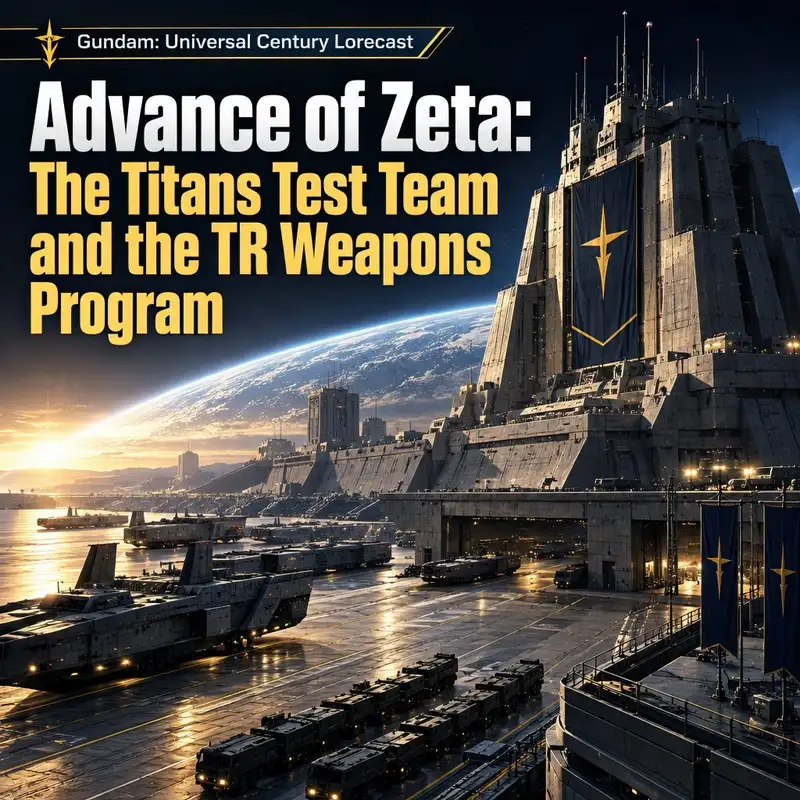
Advance of Zeta: The Titans Test Team and the TR Weapons Program [Manga]
Near the end of the Gryps Conflict, Eliard Hunter receives an order that captures the entire tragedy of the Titans Test Team. The Gundam TR-6 Woundwort is too valuable to leave behind, too dangerous to surrender, and too closely tied to a collapsing command structure to preserve at any cost. Eliard is ordered to abandon it and destroy it rather than allow it to become a prize in the struggle around Gryps Two, the colony laser. Years of research, combat testing, classified maintenance, pilot training, and technical ambition arrive at a denial mission.
That is where the history of the Titans Test Team has to begin. Not with a list of configurations, and not with the familiar temptation to treat every Gundam-type machine as an automatic symbol of victory. The TR program was a serious effort to develop adaptable weapons under the pressure of real war. It created capable pilots, valuable data, and machines with impressive local utility. But it also revealed a harder truth. A military institution can improve its weapons faster than it improves its judgment.
The Titans built the TR program because they wanted more than another mobile suit. They wanted technical prestige, a dependable advantage over irregular opponents, and a source of leverage within the Earth Federation Forces. By the time the Woundwort had entered the story, those goals had become inseparable from the Titans’ political crisis. The organization had expanded its power, widened its enemies, and damaged its own legitimacy. In that setting, the destruction of an advanced prototype was not simply a battlefield precaution. It was the final admission that a weapon system could not save the institution that commissioned it.
The formation assigned to turn theory into military practice was the Titans Test Team, usually known as T3. Based at Konpei, the former Solomon fortress, T3 was responsible for testing new mobile suits, weapons, equipment, and tactics. In principle, it was a specialized development organization. In practice, it became something more dangerous. The team’s experimental machines were sent into real operations against armed opponents. Its pilots were expected to gather data, assess systems, develop tactics, survive combat, and accomplish the mission. The laboratory was a war zone.
Its principal mobile base was the Alexandria-class cruiser Aswan. Under Captain Otto Pedersen, the ship carried the command staff, technical personnel, records, supplies, and mobile suits that made the test program possible. The Aswan was not just a backdrop for launches. It was the place where equipment was inspected, weapons were loaded, damaged machines were recovered, and mission results were turned into technical judgments. It was also where field orders met the human consequences of those orders.
Within T3, the Black Otter squad formed the heart of the manga’s combat story. The squad was led by Wes Murphy, a veteran whose experience reached back through the One Year War and the Delaz Conflict. Murphy understood that a test unit could not survive by treating every engagement as a demonstration. He had to turn incomplete equipment and ambitious young personnel into a coherent fighting formation. His role was part squadron commander, part instructor, and part shield between his pilots and the demands of a larger organization.
Eliard Hunter joined this environment as a young Titans officer. He is not important because he begins as a perfectly formed ace, nor because the manga asks the audience to assume that youthful conviction automatically becomes wisdom. He matters because his service forces him to confront the gap between the official language of duty and the actual character of the institution issuing orders. He learns technical discipline, combat responsibility, and loyalty to comrades. He also learns that obedience inside a classified military system does not remove personal responsibility for what that system becomes.
Carl Matsubara stands beside him as rival, comrade, and source of technical continuity within the team. Their relationship gives the Black Otters a professional core. Competition matters in an experimental formation because pilots are constantly being measured, compared, and asked to master unfamiliar systems. But competition without trust would have made the unit unusable. Carl’s practical knowledge and rear-support role help show that mobile-suit development is not only a matter of the person in the cockpit. It also depends on people who understand equipment, records, recovery, and what happens after a sortie ends.
Audrey April is equally central to the team’s function. She is not simply present to complete the squad’s social chemistry. Her position connects piloting to operational evaluation. A test organization requires people who can judge how a machine behaves under pressure, how equipment affects workload, and whether a promising design can be operated reliably by a human being who is tired, frightened, injured, or receiving incomplete information. The manga’s Black Otters work because their members are not interchangeable. Each carries a different part of the burden.
The squad’s rabbit imagery is easy to overlook, but it suits the history. On one level, it is unit identity, the sort of visual language militaries use to create cohesion in an impersonal institution. On another, it is an uncomfortable reminder that the Black Otters are repeatedly exposed to systems still under evaluation. They are not laboratory animals, and the manga does not present them as passive victims. They are trained officers and pilots. Yet they are also personnel placed at the sharp end of a procurement process that needs real combat data.
That distinction matters because T3’s local professionalism should not be mistaken for a complete picture of the Titans. Pedersen, Murphy, Eliard, Carl, and Audrey operate within a particular command culture aboard a particular ship. They have room for loyalty, skepticism, and technical seriousness. They remain subordinate to higher Titans authority. Their ability to act responsibly depends on orders, intelligence, fuel, parts, and political decisions made elsewhere. A disciplined unit can mitigate bad circumstances. It cannot permanently escape the institution that owns it.
The first major expression of the TR program’s approach was the Gundam TR-1 Hazel. The Hazel was derived from the GM Quel, a machine already associated with Titans service. That origin was significant. Rather than build every test article from nothing, the program began by adapting an existing military frame. This reduced some development risk while allowing engineers and pilots to examine new ideas in propulsion, equipment mounting, weapons integration, and mission flexibility.
The Hazel’s Gundam-style head gave the machine its immediate visual identity. Its enhanced propulsion, movable booster equipment, shield booster, and experimental energy-pack beam rifle gave it a more practical purpose. The system was designed to test whether a familiar base frame could support more ambitious mobility and weapons concepts without becoming impossible to operate or maintain. The question was not simply whether a pilot could make the machine perform impressively in a brief engagement. The question was whether the equipment could be fitted, supplied, repaired, and used under operational conditions.
The shield booster illustrates the kind of problem the program was trying to solve. A component that combines defensive and mobility-related functions can make a mobile suit more adaptable. It can also impose penalties in handling, maintenance, storage, and pilot workload. Equipment that looks elegant in a technical diagram has to survive launch procedures, combat damage, hurried inspection, and the practical limits of a ship’s hangar deck. T3 existed to discover those limits, even when discovering them placed its personnel in danger.
The Black Otters were sent into combat because the Titans could not separate experimentation from operations. The official requirement to suppress remnants created a constant demand for mobile-suit forces. At the same time, the development program needed realistic evidence. A machine tested only in controlled conditions reveals little about how it will behave when its pilot is exhausted, the enemy is maneuvering unpredictably, communications are degraded, and recovery is uncertain. Real combat generates valuable information. It also charges for that information in human lives and material loss.
Combat testing could reveal whether new boosters altered handling at the moment a pilot most needed precision. It could show how a weapon behaved after repeated use, how armor and joints responded to damage, or how quickly technical crews could diagnose failures between sorties. It could expose weaknesses in mounting systems, ammunition arrangements, cooling, seals, and cockpit ergonomics. It could also reveal the less visible problems that shape military effectiveness: whether pilots trusted the equipment, whether commanders understood its limits, and whether maintenance crews could keep pace with changing configurations.
Those are valuable lessons, but they come with an ethical and operational cost. A test team in a war does not have the luxury of declaring an experiment unsuccessful and returning to a safe range. If a system fails under enemy fire, the pilot still has to get home. If the mission changes unexpectedly, the unit still has to adapt. If a damaged machine cannot be recovered, its technical value may become an intelligence loss. The Black Otters were therefore not only evaluators. They were a combat unit whose survival was part of the experiment.
Wes Murphy’s command role becomes clearer in that light. He could not control the political direction of the Titans, and he could not guarantee that every order would be wise. What he could do was impose tactical discipline. He could judge risk, preserve cohesion, and ensure that young pilots did not confuse a new machine’s potential with invulnerability. That kind of leadership is not glamorous, but it is what keeps an experimental formation from becoming a collection of isolated pilots chasing performance figures.
Even then, the squad operated with incomplete information. Classified programs compartmentalize knowledge by design. A pilot may understand the machine, the immediate mission, and the local enemy. That does not mean the pilot understands the political purpose behind a deployment, the institutional rivalry shaping procurement, or the consequences of a success elsewhere in the command chain. T3’s personnel were trusted with advanced equipment. They were not necessarily trusted with the entire truth about the war in which they were being asked to use it.
The Aswan made this kind of combat testing possible. A mobile suit is often presented as the decisive object in a battle, but it is strategically mobile only because ships and bases move it. The Aswan provided launch facilities, recovery capacity, planning space, technical labor, spare parts, ammunition, propellant, medical support, and a place to preserve the records that turned sorties into development data. Without the ship, the Hazel and its successors would have been expensive machines with no means of sustained employment.
Under Minovsky interference, the ship’s command function was especially important. The Aswan could not assume that it possessed a perfect picture of a battle. Orders might be delayed, fragmented, or based on incomplete reports. Mobile-suit teams needed clear mission intent before launch because they could not count on headquarters correcting every decision in real time. The ship had to coordinate recovery while protecting itself, monitor damaged units, and decide when preserving a pilot or machine was more important than pursuing an uncertain tactical advantage.
Maintenance was not an afterthought. The TR program’s strength lay in its adaptability, but adaptability creates a hidden administrative burden. Interchangeable equipment requires spare components, trained technicians, documentation, inspection procedures, storage space, calibration, and configuration control. A modular machine is useful only if everyone involved knows what has been installed, what remains compatible, what has been damaged, and what can be safely used on the next sortie. Bureaucracy is rarely dramatic until it fails. Then it becomes visible in a machine that cannot launch.
The later presence of the Salamis Kai-class Izmir reinforces this point. The exact pattern of support matters less than the broader fact that T3’s advanced equipment needed a network around it. The Aswan and Izmir were not merely transport platforms. They were parts of a mobile industrial system. They carried the people and supplies necessary to make field modification possible. They also represented vulnerable concentrations of expertise. Losing a prototype was serious. Losing the technicians, records, tools, and shipboard support that made the prototype usable could be worse.
For that reason, tactical mobility should not be confused with strategic independence. A TR machine might change configuration, move rapidly, and fight in several environments. It still depended on naval infrastructure and skilled labor. It needed a safe enough operating base to return to. It needed logistics to sustain it, and intelligence to send it somewhere useful. The Titans’ interest in flexible weapons was understandable. Their mistake was to imagine that technical flexibility could compensate for the political and command failures that were making their entire war less coherent.
That separation became visible in the fracture represented by Maxim Gunar. In the broader narrative around T3, Gunar had been associated with Murphy before defecting to the A E U G with a high-mobility Galbaldy Beta test machine. The immediate military loss was significant. A trained pilot, an advanced machine, and technical knowledge had passed to an opponent. But the deeper importance was institutional. A weapons program can secure its documents and compartmentalize its research. It cannot guarantee the loyalty of people who decide that the parent organization no longer deserves their service.
Defection is often described as a security failure, which it is. But it is not always solved by tighter security. Gunar’s departure demonstrates that military loyalty is shaped by memory, trust, personal relationships, and political judgment. A pilot does not become an extension of a machine merely because the machine is classified. The more the Titans treated technical superiority as a substitute for legitimacy, the more vulnerable they became to the human beings required to operate that superiority.
Murphy’s connection to Gunar makes the event particularly revealing. Veterans may share history without sharing conclusions. Service in earlier wars can create bonds of trust, but it can also leave people with different lessons about authority, sacrifice, and the use of force. The Titans could recruit experienced personnel and equip them with superior machines. They could not erase the moral and political interpretation each person brought to the next conflict. The Universal Century repeatedly demonstrates that veterans are not empty containers for state policy.
Otto Pedersen’s relative skepticism toward the Titans’ more extreme tendencies also matters here, though it should not be exaggerated into proof that T3 stood outside the system. Pedersen remained a Titans commander. He commanded a ship and a program that served Titans objectives. Yet his concern about the consequences of higher command decisions shows that the organization was not a single mind. Institutions contain different levels of conviction, opportunism, professionalism, fear, and dissent. That complexity does not absolve the institution. It explains why its collapse could be uneven and painful.
The Black Otters’ local cohesion likewise cannot redeem the Titans as a whole. A squad can be loyal to one another while serving a destructive political project. Professionalism can reduce waste, protect comrades, and impose discipline. It can also make an organization more effective at carrying out policies that should have been resisted. The manga’s strength is that it allows the viewer to see the humanity of the people inside T3 without asking that their humanity erase the larger record of Titans repression and overreach.
Faced with a widening war, the TR program did not respond by becoming simpler. It moved toward a more ambitious modular architecture. The central idea was that a core machine could accept equipment suited to different missions and environments. This offered an appealing answer to uncertainty. Rather than build separate machines for every possible problem, the Titans could develop an adaptable system, retain high performance, and configure the weapon around operational need.
There was sound procurement logic in this. An organization that expects to fight in changing environments wants flexibility. A test team that can gather feedback quickly may be able to refine equipment faster than a conventional acquisition system. Concentrating advanced development in a politically favored formation also gave the Titans direct control over valuable expertise. T3 could test a concept, revise its use, and return it to combat without waiting for the slowest parts of a larger bureaucracy.
But modularity has costs. Every new option creates another maintenance demand. Every configuration creates another training requirement. Pilots must learn how changes in weight, thrust, weapons, and handling affect the machine. Technicians must know which components fit together, which require special inspection, and which cannot be substituted in the field. Commanders must know what a machine can actually do in its current arrangement, not what it might do in an ideal configuration described on paper.
This is the danger of field urgency. A war creates pressure to use every available advantage immediately. A development program needs time to establish safe procedures, collect reliable data, and correct faults. When the same organization is responsible for both combat operations and weapons testing, urgency can outrun evaluation. The result may be a machine that is technically remarkable but operationally fragile, or a crew asked to master too much too quickly because the command situation has become desperate.
The TR concept therefore reflected both competence and anxiety. It was competent because it recognized that modern warfare demands flexibility, integration, and rapid learning. It was anxious because the Titans were trying to create a technological answer to a problem that had become political. They wanted systems that could respond to every contingency. But no configuration package could repair fractured command relationships, restore trust among colonies, or make authoritarian security policy appear legitimate.
The Gundam TR-6 Woundwort represented the culmination of this approach within the manga’s record. Unlike the Hazel, which adapted an existing frame, the Woundwort was the first newly designed core machine of the TR series. It was intended as the central element in a modular weapons system, able to work with interchangeable options for different combat requirements. That made it more than another upgrade. It embodied the program’s ambition to turn flexibility itself into a military system.
The Woundwort should be understood as a genuine achievement of engineering and operational design. It concentrated the lessons of earlier work into a dedicated core platform rather than relying only on successive modifications of older equipment. It represented a mature version of the Titans’ belief that a smaller number of highly capable, adaptable systems could answer a wide range of missions. In local terms, that belief had merit. A well-supported advanced machine can give a skilled pilot options that a standard unit may not possess.
But the Woundwort was not a mass-produced solution waiting to transform the entire war. The manga does not establish a fleetwide force of equivalent machines or a broad industrial system that had made the Titans’ conventional formations obsolete. Its significance was concentrated. It was valuable because it was rare, advanced, and tied to specialized personnel. Those same qualities made it difficult to replace and dangerous to lose. The more unique a system becomes, the more its destruction can matter locally and the less it can solve a larger war by itself.
The Titans’ leadership increasingly behaved as though concentrated technological power could produce concentrated political control. The Woundwort exposes the weakness in that assumption. It could improve a pilot’s chances in a particular engagement. It could provide data for future development. It could symbolize the program’s sophistication. It could not reverse the Titans’ isolation from the political forces gathering against them. It could not restore unity to a command structure strained by rival agendas and deteriorating strategic judgment.
By the struggle around Gryps Two, those limits had become impossible to ignore. The colony laser was not simply another objective on a tactical map. It was strategic infrastructure of enormous destructive potential, and control of it had implications far beyond the immediate forces in contact. Any battle to recapture or deny such an installation involved competing commands, shifting alliances, and the risk that a momentary military advantage might become a catastrophe for the wider Earth Sphere.
The Titans were no longer fighting under the relatively simple logic of a counter-remnant mission. They faced the A E U G, Axis, and the consequences of their own political choices. The battlefield was confused because the war itself was confused. Alliances were unstable. Command authority was contested. Information was incomplete. In such a situation, a test formation like T3 could still fight effectively, but it could not create a coherent strategy where higher command had failed to provide one.
The Black Otters’ experience mattered because they had spent years learning how to operate unfamiliar machines under pressure. They understood the value of discipline, support, and adaptation. Yet no amount of squadron competence could guarantee control over events at the scale of Gryps Two. A mobile-suit team can protect a route, cover a withdrawal, delay an enemy, or deny a machine to capture. It cannot by itself recover an institution’s authority once that authority has been hollowed out.
The order concerning the Woundwort must be seen in that operational context. Eliard is directed to abandon and destroy the machine rather than let it be captured. This is a denial measure. Militaries destroy equipment for sound reasons when recovery is impossible and capture would give an enemy access to sensitive technology. There is no need to romanticize the order. It reflects practical concern over security, intelligence, and the danger of allowing an advanced system to pass into hostile hands.
But it is also an anti-climax for the TR program. The machine had been built to embody adaptable power. At the decisive moment, its value lies not in what it can do but in what the enemy must be prevented from learning or using. The Woundwort remains tactically important, but it has become strategically defensive. The Titans are no longer using superior technology to shape the war. They are trying to keep fragments of that technology from becoming evidence of their defeat.
The outcomes around Gryps Two have to be separated carefully. Tactically, T3’s personnel and equipment could still influence local engagements. Their training and adaptability were real advantages. Operationally, the struggle demonstrated the difficulty of controlling strategic infrastructure amid fractured command and multiple hostile forces. Strategically, the Titans could not regain their position in the conflict. Their military power had become disconnected from a sustainable political purpose.
Politically, the organization was collapsing under the weight of its own methods. The Titans had used exceptional authority to answer real security threats, then expanded that authority into repression. They had developed elite formations and advanced weapons, but they had not built consent. They had cultivated fear, but fear is not the same as legitimacy. Once their opponents could present the Titans as an autonomous force acting against the Federation’s own people, technical superiority became less a source of stability than another sign of dangerous separation from the society they claimed to defend.
The surviving account is further complicated by the way the narrative is framed in early Universal Century eighty-eight. The later military-trial context reminds us that the history of a classified weapons program is never preserved in neutral form. Orders, logs, technical reports, after-action records, and testimony are all produced by people and institutions with reasons to protect themselves. A defeated organization may conceal its failures. Survivors may emphasize the limits of their authority. Investigators may seek individual culpability where the deeper cause was institutional design.
That does not mean every record is false. It means records have to be read with attention to their origin. A pilot’s testimony may accurately describe what happened in a cockpit while still omitting the political assumptions behind the mission. A command log may establish an order while saying little about whether the order was wise. A technical report may explain why a machine failed while avoiding the question of whether it should have been deployed in the first place. The history of T3 is inseparable from that problem of evidence.
What did the Titans Test Team achieve? It achieved a great deal at the tactical and technical levels. It tested advanced systems under conditions no peaceful range could reproduce. It produced combat data about mobility, weapons, pilot workload, maintenance, recovery, and modular equipment. It developed a cadre of personnel able to operate at the difficult intersection of engineering and combat. It demonstrated that adaptable systems could give a small, skilled formation unusual flexibility.
It also proved that a test unit could become operationally useful. The Black Otters were not simply technicians wearing uniforms. They became a deployable combat team. The Aswan and its support structure showed how a shipboard formation could turn experimental machines into usable military assets. T3’s methods created knowledge that ordinary line units might not have generated as quickly. In a narrower military sense, the program justified much of its existence.
Yet it failed in the ways that mattered most to the Titans’ long-term position. It did not prevent defections. It did not resolve command fragmentation. It did not make the Titans’ political repression sustainable. It did not turn advanced machines into a replacement for broad military legitimacy. The program could help a squadron survive. It could not explain why the organization was fighting an expanding civil conflict or why so many people had come to see Titans authority as a threat rather than protection.
The operational burden was part of that failure. T3’s adaptability depended on scarce ships, skilled technicians, classified records, specialized equipment, and trained crews. The program was flexible, but not simple. It required more support, not less. In a stable institution with clear strategic priorities, that burden might have been acceptable. In a collapsing command environment, the same complexity became a vulnerability. Every unique component, every specialist, and every recovery operation created another point where the system could break.
The civilian and moral dimensions cannot be separated from that burden. Weapons testing in a civil conflict is not an abstract technical process. It takes place around colonies, routes, bases, and communities already living under the pressures of surveillance, political violence, displacement, and military mobilization. The people placed at risk by these operations were not entries in a test report. They were residents, workers, transport crews, families, and service personnel whose lives were affected by decisions made far above the cockpit.
The TR program’s greatest historical meaning lies in this contradiction. It showed that sophisticated weapons could be developed through combat and that a small formation could become remarkably capable when pilots, technicians, ships, and doctrine learned together. But it also showed the limit of that achievement. The Titans could build adaptable machines, gather data, and create highly capable crews. No modular weapons system could compensate for political repression, fractured loyalty, deteriorating command, and a war whose central problem was legitimacy rather than firepower.